GHK-Cu: liver tissue to skin
The history is expansive. The human evidence occupies a much smaller, mostly topical space.
The plasma discovery
GHK is a chain of three amino acids: glycine, histidine and lysine. It occurs naturally in the body; GHK-Cu is that peptide bound to copper. The skin-regeneration review traces the original discovery to a factor isolated from human plasma that affected protein synthesis in older liver tissue in laboratory work.
That origin makes the later skincare interest less arbitrary to me. It also makes the exuberant language around whole-body rejuvenation harder to excuse. A response in cultured tissue is a starting observation, and a topical cosmetic history concerns a particular kind of exposure. Each proposed expansion needs experiments of its own.
Skin collagen
In cell work, GHK-Cu stimulates fibroblasts, the cells that build the skin’s supporting material, to produce collagen and other matrix components. Copper also supports the enzyme involved in cross-linking collagen and elastin. The review of regenerative actions brings these repair mechanisms together with gene-expression analyses. The latter are laboratory and database findings; they leave open how much of that activity becomes a useful effect in a living person.
Human topical studies are smaller and more specific. The 2025 anti-wrinkle review reports increased procollagen synthesis in 70% of GHK-Cu-treated subjects in the reviewed work, compared with 50% for vitamin C and 40% for retinoic acid. These percentages describe subjects with an increase, rather than the amount of extra collagen produced. I give the subject count more weight than the size of an anti-aging claim on a skincare page.
Getting through the skin
Delivery is a persistent difficulty in the topical formulation literature. A promising response from exposed cells still leaves the outer skin barrier to cross.
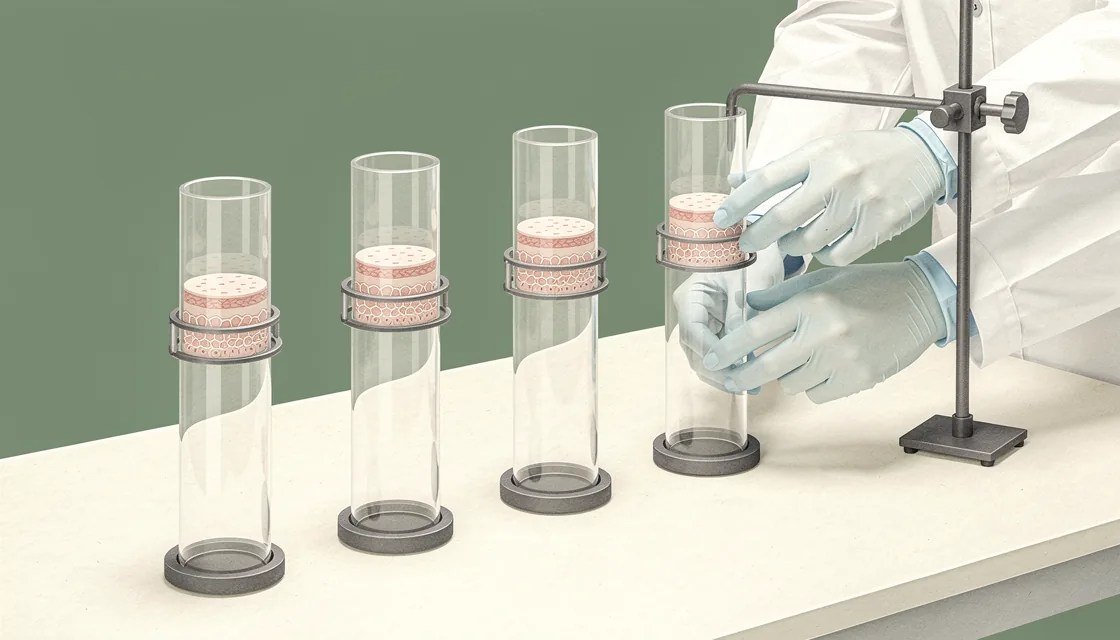
An experiment using human skin outside the body measured copper penetration and retention after application as GHK-Cu. Dermatomed skin—skin prepared to a particular thickness—retained copper in a dermal depot over 48 hours. That is a useful account of where copper went under those experimental conditions. It cannot establish the circulation or safety of injected GHK-Cu. No validated human pharmacokinetic basis for that systemic use is available in the research covered here.
Hair trial
The controlled hair-growth trial involved 45 men with androgenetic alopecia over 6 months. Its topical preparation combined GHK with 5-aminolevulinic acid. Hair-count increases were 52.6 and 71.5 in the two active groups, versus 9.6 for placebo, with no adverse events reported in any group. Those findings concern the tested combination. They cannot isolate an effect of GHK alone or of copper-bound GHK-Cu.
This is the kind of reused result I distrust: a preparation with several ingredients gradually becoming evidence for whichever ingredient someone wants to discuss. The retatrutide combination question has an even larger gap, since the cited studies do not test that pairing at all.
Cosmetic experience and safety
Skincare accounts describe softer lines, firmer-feeling skin and better hydration, alongside redness, dryness, breakouts or disappointing results. These are anecdotal accounts rather than clinical evidence. Reports about injected GHK-Cu are anecdotal as well, with the additional problem of an unapproved route lacking validated human pharmacokinetic data.
The formulation review also discusses stability: vitamin C and low-pH acids can disrupt the copper complex. Topical Copper Tripeptide-1 has a cosmetic history; GHK-Cu has no FDA-approved drug indication. Well-controlled human pharmacokinetic work would resolve the systemic-use gap. Another list of cellular pathways leaves those doubts untouched.